

Made in Italy is in danger, always Covid's fault?

Italians are lucky. Mostly if they work in the fashion industry.
Why? Because we can count on a competitive advantage that other nations envy us and that is not all our own work.
What I’m talking about? Obviously about Made in Italy brand reputation.
Perhaps we are so used to hearing about how important Made in Italy is, how valuable Italian productions are that we no longer give it the right weight. And above all we are used to think that Made in Italy is important and that it will always be.
But is not so.
Made in Italy is in danger and in this case Covid is not involved.
But let's proceed in order.
Brand Finance, the leading strategic consulting and brand valuation firm, annually compiles a comprehensive report on the world's leading national brands and the impact a country's reputation and image have on governments, investors, students and consumers.
According to official statistics released last year, the Made in Italy brand has a value of 2110 billion dollars, a result that places Italy in tenth position in the ranking of the most successful and profitable national brands in the world. And the fashion industry alone contributes $ 20 billion. An extremely positive result.
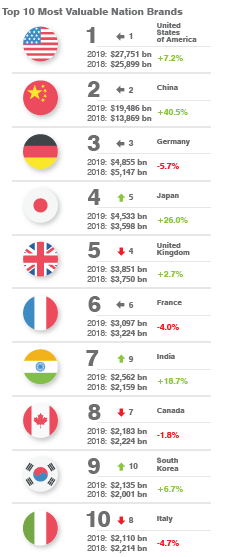
If we read the data more carefully, however, we see that the overall value has undergone a decline compared to the previous year (2018), passing from ninth to tenth position. And the predictions for 2020 are certainly not encouraging.
If we can blame Covid and the lock-down for this year's predictions, what could be the excuse for last year's decline?
Among the culprits there is certainly the nature, not always out in open, of the supply chain which in recent years has raised several questions about the origins of the production of some Italian brands: news of underpaid workers, illegal workers and tax evasions these are just some of the news that have occupied the front pages of the newspapers.
In November 2019, for example, the police raided a manufacturing company in the Naples area and found 56 illegal workers out of a total of 78: a truly monstrous percentage.
Or in Osmannoro, in the province of Florence, where 31 Chinese leather goods companies have been closed: in this case the problem was not "only" relating to undeclared workers and illegal workers, but also the serious conditions of dirt and dilapidation of the buildings and the use of storage rooms such as dormitories or illegal kitchens.
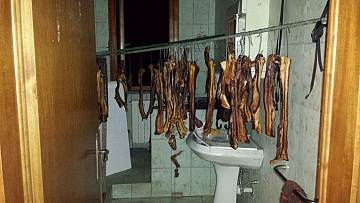
There would be other images I could attach, but I don't want you to have nightmares tonight.
This news certainly does not positively affect the reputation of a nation, but rather helps to give it a negative image.
If we also add to this the fake Made in Italy scams I talked about in the previous article, we can say that our supply chain and our Made in Italy are in danger.
In the video I published a few weeks ago, I told you about some instrument to protect Made in Italy and I gave you some tips on how to protect yourself from your supplier.
And if I do so, it is because I primarily demand them from my suppliers, so I can guarantee my customers the most total transparency on the raw materials and processes I use for the production of belts.
That’s what a supplier who cares about his customer should do, a supplier who wants to establish a collaborative relationship with his client: what's the point of cheating your customer? Treat him badly or even make him risk criminal proceedings?
This is what my team and I fight against every day: those crafty suppliers who throw mud on our supply chain and our reputation; and as you have seen, they also compromise the reputation of the Italian system.
This phrase may seem exaggerated to you but it is the famous "butterfly effect", or the idea that small variations in the initial conditions produce large variations in the long-term behavior of a system.
Could the flapping of a butterfly's wings trigger a hurricane thousands of miles away?
And this also applies to Italy's fragile economy and reputation.
And even if you now have a reliable manufacturer of Made in Italy belts, an efficient quality control that, in addition to verifying the quality of the goods, also physically checks the working conditions and the origins of all the raw materials that are used for the production of your belts, you must never let your guard down.
Because around the corner there could be a seizure or, still worse, a criminal case or you could be forced to pull back all the belts you had sold and destroy them, obviously at your expense.
So choosing the right supplier is the first step to avoid a series of negative consequences that worsen exponentially.
And the specialized producers are the ones who can save “Made in Italy” brand and help companies and brands to have products with a higher sell out and thus increase their sales.
Economically, in fact, Made in Italy is important because it increases the perceived value of the product and influences the choices of consumers; Have you ever wondered where this innate concept of superiority of Italian products comes from?
I searched through my childhood memories and the stories my father used to tell me as bedtime stories and I defined what for me are the seven cornerstones of Italian productions.
Are you ready?
There is none: Italian leathers are the best in the world.
The softness, scent and silkiness of vegetable tanned leathers are unrivaled!
In my experience I have visited many tanneries, both in Italy and abroad, and none can compare with ours, especially with those of Santa Croce, the cradle of Italian tanning art.
And obviously I'm not the only one who praises them: the last one, in chronological order but certainly not of importance, was the CEO of Birkenstock who told in an interview reported on La Conceria that his biggest concern during the pandemic was the fear of not being able to find and use its reference leathers; a fear so deep that it led them to buy all the leather they could find, despite having a warehouse full of products.
The second point is the great manufacturing tradition.
In fact, it is said that leather goods became fashionable in Italy in the 16th century, when large leather products became luxury goods and also became commonplace for most of the population. And from there this artisan tradition has been handed down from generation to generation, from father to son, giving it that set of skills and experience that makes it stand out from the rest of foreign manufacturers.
Obviously it is not enough to have excellent raw materials and great processing skills to create valuable products: design is essential and in this case too Italy can count on a long tradition.
But here I am not talking about design as mere aesthetics: for me, design must reflect the identity of the brand and must translate the values of the brand itself into practice, always respecting our Italian DNA which, very often, is imitated abroad.
But the advantage of Made in Italy is not only at the product level.
Have you ever placed an order from China?
If you are one of the few who answer no, I'll help you: delivery times from China are usually 90-120 days and a long delivery time results in an increase in warehouse occupation and a larger cash outlay.
In a historical period like this (in the immediate post lock-down) who can afford it?
An excellent Italian company, on the other hand, is able to deliver relatively quickly and this means a lower cash outlay, a constantly updated product range and a more interesting proposal.
In addition to having longer delivery times, productions from the Far East always require very important quantities to be able to maintain a low price and this for you translates into a higher cash outlay and greater warehouse occupation.
As mentioned at the beginning, prestige is another of the fundamental points of Made in Italy productions.
Let's think to a brand that has ambition to position itself at a high level: if the label had the words "Made in China", what perception would you have of that product?
And if it said “Made in Italy” would your perception change?
Here, this is what I am referring to when talking about the prestige of Made in Italy leather goods.
How many times have you been left standing your supplier? Or how many times have you received the goods late?
Or to spend hours on the phone trying to get information about your collection and to be bounced around hearing only excuses?
Without forgetting the difficulty of having to communicate using another language: if you are lucky with English (even if we know that the English spoken in the Far East is not very understandable), otherwise you are forced to rely on a qualified person to manage communications. Not exactly the most convenient and fastest solution.
A modern Italian company, on the other hand, gives you no worries: if you then buy from a leading company in the leather goods sector like us (😁) you are safe and sound!
Especially because in your day there are not only small leather goods and belts to think about ... quite the contrary: different collections, different accessories and different suppliers weigh on your shoulders.
At least for a small part simplify your work and let us help you.
As you well know, I am a leather goods supplier, I have been producing small leather goods for more than thirty years and my reflection on the importance of Made in Italy is viscerally linked to my experience and my passion for leather.
But I bet many of these points are common to other industries.
And what do you think? Do you think a brand should produce in Italy?
PLEASE WRITE ME IN THE COMMENTS below or by e-mail to danielgiaconia@outlook.com YOUR OPINION OR IF THERE IS A TOPIC THAT IS PARTICULARLY AT HEART AND YOU WOULD LIKE TO TALK TO ME.
Thank you very much for taking the time to read this article.
Daniel Giaconia


Comments